
To Be Temporary Forever
On HELEN OF NOWHERE and IT FEELS SO GOOD TO BE A VICTIM

The difference between your pretentious-performing-lit-bro who moans, like a tic, “THERE IS NO GOOD LITERATURE BEING WRITTEN NOWADAYS,” and someone who complains, now and then, about the novels with their own B&N tables, is that the latter might have read Ulysses when it came out, and the former would have said something like: “THERE IS NO GOOD LITERATURE BEING WRITTEN NOWADAYS.”
I use Ulysses as an example because it is the kind of book that is obscurely referenced as “great” or “genius” while leaving out mention of the hurdles Joyce had to jump just to publish a single copy. People were CHARGED just for printing excerpts of it in the states. And when it finally did go into print, in France, the US post office SEIZED AND BURNED copies of the novel. And they were in the minority!—few others immediately recognized the novel’s potential.
That is to say,
great books not getting published at all, LET ALONE not being on some NYT list, is no new phenomenon.
What is important to remember—and therefore easily forgotten—is that big publishing houses are not interested in finding great novels; they’re interested in sales. And so if bad books are being published, it is because lots of people are buying them.
Reader, it is your fault!
And my fault…
And everyone’s fault…
Colm Tóibín claims to receive several emails each night from (usually American) readers enraged that his novel’s endings are not Middlemarch-like: laying out what will happen to each and every character for years and decades—perhaps even centuries—to come. Now imagine what those readers would think about Ulysses—or, the example Tóibín gives, Portrait of a Lady by Henry James.
It’s even wilder because (and this is not a diss): Tóibín writes for the masses! He is a very talented craftsman, and an excellent scholar—good for the world of literature in many ways—but to say he is pushing some kind of boundary would be a stretch.
But it is the boundary pushing books that get remembered!
As a general rule: the book that everyone is talking about this year will almost certainly be forgotten two or three decades from now. And that’s not to say everyone eventually loves the great books—most people buy Ulysses nowadays for the same reason they buy a new bestseller—because they want to be a certain kind of person who reads a certain kind of book—but at least it’s on the shelves! Those bestsellers, someday, won’t be.
So,
let’s turn to two books I read this week, both published on very small presses, both, I very much believe, pushing boundaries:
—Helen of Nowhere by Makenna Goodman, published by Coffee House Press. Coffee House Press is well known, actually—that is to say, they’ve published some rather successful books—but they are an extremely small nonprofit publishing house, releasing less than twenty books a year in all genres.
and
—It Feels So Good To Be A Victim by Emma Newman-Holden, published by Dream Boy Book Club. I’d never read anything from this press, but they market themselves as for “readers who may not traditionally engage with books,” and have a real interesting backstory.
Apologies for starting this essay with a rant. I think I’ve read too much Schopenhauer this week!
OK…
HELEN OF NOWHERE BY MAKENNA GOODMAN is about the corruption of thought and literature.
Our unnamed main character is a disgraced Professor, recently fired, and waging war in his mind against the women responsible for it.
Does he hate these women because he was fired? Or did he get fired because he hates them?
The opening to the novel suggests the latter:
I think it’s okay to tell a woman she’s beautiful once a year. Any more than that and her life will be about being beautiful, entirely. Anything less and she’ll feel a lack of love and attention. My wife always said I never told her she was beautiful enough. But like I said, I don’t think it’s good for women.
WILD START…
The Professor then discusses his ideas—the ideas that, he says, got him thrown out of the university. The problem? They are beyond vague. He talks about ‘divinity in nature,’ about living in a state of ‘total simplicity’—ideas that sound kind of interesting but don’t mean anything at all.
Nature is the teacher, not I, is what I always told my students.
Of course, he cannot explain the critiques of these ambiguous ideas without further ambiguity:
Who is allowed to feel at home in this so-called nature, they asked, and what are the conditions informing the peace provided those people by the simplicity I espoused? The new generation of teachers said that my approach to teaching was a purity test, the imposition of ritualized discomfort in nature as a means of cultivating virtue.
It is clear he views teaching as a form of power. In this way, Goodman diagnoses a flaw within scholarship: that it may seek to create hierarchies of knowledge, a kind of literature that is both read and written with the goal of being better, and not knowing more.
And Goodman does such an insane job of toeing the line with this character. The kind of person she is insulting—though it’s true the insult is aimed at the system, not the individual—might find themselves feeling praised instead. This can be viewed as a sign of self-awareness in the Professor, that he knows how to sprinkle in one or two interesting thoughts or arguments, something one might instinctively agree with, at least enough to overlook the rest of his BS.
But he slips up! And the slip ups are important.
Sometimes it can take pages on pages, you might find yourself nodding, okay, maybe he’s more interesting than I thought (he claims to crave unhappiness, to need it to write well), but it’s clear he’s lying to you, to himself. And every now and then he reveals something damning,
I was delighted by her. Though she also repulsed me. When she was a student, and later when she became my wife. She annihilated me by knowing things I didn’t know. My desire was something about her I could control, and ultimately, marrying her was the greatest revenge against her brilliance. When she was my student, deep down, I wanted to lick up and down the route between her breasts. But she was my student, and so I kept this desire sublimated, entirely. I tell you: entirely.
LIKE WHAT?
Of course, a system based around control, where something like this can happen, is one that should be eliminated. But he takes offense to that,
I had been betrayed by a system that once valued mastery and now seemed to value its redistribution. It wasn’t fair, and it was dirty.
because he has built his life around it.
The dog officially took my spot on the bed. I moved into the guest room with the bad mattress. Not even the way we made coffee made sense anymore. There was only enough for one cup and a little extra, so we made coffee separately. She would go to a dance class at night and I would pretend to be asleep when she got home. I would hear her greeting the dog with such happiness. Then the shower would go on. She didn’t even think to look for me.
The book is quite short—141 pages, a small frame, and LOTS of line breaks—but there’s so much to unpack. It’s split up into six sections: 1. MAN; 2. REALTOR; 3. HELEN; 4. HELEN AND MAN; 5. WIFE; 6. MAN AND WIFE
The majority of the novel takes place in the countryside, where an unnamed realtor is trying to sell the newly-fired, newly-divorced Professor a home—a home that, she claims, was previously owned by Helen, a woman whose existence seems up for debate, who sounds eerily like the Professor himself,
Yes, professor, she became entirely separate from her generation as if she was living in a different time. She had visitors, but they were fleeing human frailty, too, and so they brought no news because they, too, were seeking to escape it.
and who also shares a strange amount in common with the realtor.
The voices in this novel—the Professor, his Wife, their Dog, the Realtor, and Helen—are, in some sense, interchangeable. The book becomes, possibly, a representation of the world as the Professor claims to view it.
I don’t want to focus too much on the later sections, because they get BIZARRE, but the ambiguity of Helen does a wonderful job of anchoring them.
At the end of the day, the Professor hates change—but, he wants you to believe he loves it, praising what is now old for its once newness.
Things should go back to how they were. They must. All he wants to be successful, to be recognized again,
I had a feeling of having been somewhere, not knowing how to get back, like understanding the route but not the means of transport
External contentment is what he’s after, and internal ignorance is no issue.
Why are stories necessary? And who are we really telling them to?
“You only love yourself,” my wife said, “you love others as a way to love yourself, to prove you can love at all. But caring is not something you do,” she said, “care is something you give.”
IT FEELS SO GOOD TO BE A VICTIM BY EMMA NEWMAN-HOLDEN is “a collection of short stories that explore parasocial relationships, rape politics, marital ennui, mental illness, and more.”
From the author’s note:
I hope I navigate these subjects in a manner that is, above all, true. This book is for fangirls and fat old sex workers. This book is for grieving mothers and autistic sons. This book is for that one person who slept with everyone at the SLAA meeting. This book is for functioning alcoholics and cigarette chain-smokers and adult women with self-harm scars. This book is for the Instagram influencer as well as the man who pays the Instagram influencer for pictures of her feet.
Truth, above all, is the sense that I get from these stories. The way we move through a world we do not understand, the thoughts we wish we did not have, the ugly manifestations of grief,
My son died. My son died and the car won’t start. The car won’t start because if you have a bad day, the universe is only allowed to make it worse, as is its right. Oh—there we go. My son died and the car is starting because one must always be doing something, especially when they’re incapable of doing so. I drive, I steer, I stop, as if these things mattered, as if the world would stop spinning, as if I would feel worse if I rammed into that tree, crashed into that police car, ran over that girl on the scooter…My son died. My son died and my husband is making salad. Salad is the least-food of all foods, and that is why he is making it, because once life stops happening for you, you aren’t allowed to enjoy anything.
are so powerfully executed.
Newman-Holden’s world-building moves away from an outdated sense of clarity. These stories take place in disappointingly shitty hotel rooms, in faceless therapists’ offices, in obscure clubs in which one room is “reserved for an ongoing food fight,” one for “snorting ketamine in the nooks between Instagram influencers’ toes and fingering any wait staff who are itching for a big tip,” and one that contains “a giant ice sculpture of a buxom naked woman.”
How did this place go from a work conference to a frathouse to a courtroom so quickly? Places are evil in that way—frighteningly malleable.
What is objectively true is becoming less and less relevant; certainty may be achievable, but it is pointless
He doesn’t understand anything that’s happening right now, not a single thing. If he gave me a list of things he thought he understood right now, I’d cross every one off, big red X to each one, that’s what I’d do.
because nobody wants it:
I memorize the ingredients in case anyone asks. But no one does. No one actually cares about what’s going in their bodies; they just care for the certainty and speed at which it’s going in their bodies.
Do they want anything at all?
It’s not fun getting what you want; it’s not a relief. It just causes more problems.
Some of my favorite stories in the collection come from the transcription series:
“Transcribed Message Of An AA Member’s Speech Caught On Her Court-Ordered Parole Officer’s Voice Memo App,”
“Transcribed Message Of A Mourning Man Talking To His Dear Friend Caught On Nothing Whatsoever,”
“Transcribed Message Of A Father Talking To His Child Caught On A Forever 21’s Dressing Room CCTV,”
and the ever aptly titled, “Transcribed Message Of A Flu-Ridden Therapist’s Newest Patient Caught On Her Sony ICD-UX570 Recorder,”
I’m an only child. But it’s also confusing: I never really know how to answer that question because—well, my parents had my sister, right? Before I was even a thought. And she died when she was two years old. And then they had me. So, you see? It’s tricky. Answering that. But I—I just want to clarify, like, I usually say no. I usually say no to siblings because...obviously. Bless you. Bless yo—bless you. Wow, three in a row! That’s good luck, right? Want a tissue?
Newman-Holden has a powerful grasp on the insights that, seemingly minute, take up the most space within us.
She is, of course, the star of the family in many ways. Everyone talks about her. “My Abby would love this.” My grandmother says that constantly. As if she actually knew her. As if Abigail was able to reach the cognizance to become a person to know.
and the addition of humor just when the story begs to be serious:
Fuck, shit, dude! You got snot in my mouth! Your mucus is molesting me! Please, your nose is a fountain of death at this point—it’s actually quite unprofessional.
The endings of these stories are wonderfully real—momentary bonds over hatred, characters shifting their entire world view for the purpose of convenience, and, perhaps the most oddly heartbreaking:
Her Twitter has been deactivated for seven years, her Instagram for five. Her last email to me is dated thirteen years, two months, and sixteen days ago. My last email to her was yesterday morning, congratulating her on her eldest daughter’s communion.
This from a story titled “The Throat Goat,” about a creepy, sixty-year-old man who begins messaging a semi-famous young lady on twitter. The grace with which Newman-Holden treats her characters is sometimes shocking, but it always results in prose, in stories, in a collection, that stings.
The first story, “The Woman,” about someone sleeping with her sister’s boyfriend;
why?
because there’s an important part of my soul that is bored and unsatiated.
AND she trains AI models:
Today, I’m at home, at work, like usual, writing a persuasive essay arguing for a federally mandated tax that allows women to take off work during their luteal phase for the invisible people in my computer to plagiarize.
The shit in this book is just INSANE! It’s what is missing from literature right now, I am so serious.
Jude’s face retracts, his body backing away before his mind even thinks to. A woman crying in a clown suit is a new visual for him, and he doesn’t know the appropriate feeling to attach to it, but he feels guilty that, so far, it’s largely positive.
The kind of modern media satire that most writers shy away from:
We were watching a reality dating show about anorexic midgets getting paired with non-acting pedophiles,
The host is this overweight gay man, Mr. Cherith, whose whole schtick is sexually harassing the guests and self-deprecating humor about how fat and gay he is,
the show is about the obstacles Eddy faces as a penis-less teen trying to fit in. There’s an episode where he scores a date with the head cheerleader, Brittany De Bastiani, so he ties a cucumber around his waist with plastic wrap, just for the visual illusion, you know, except Brittany ends up actually stroking his penis outside of his pants and this causes the cucumber to break in half and Brittany screaming and driving Eddy to the ER, which got a good laugh out of me, I’ll be honest.
The pessimistic, nearly Houellebecqian attitudes to our ritualistic lives:
I am not happy, but I am easily distracted, and that’s all anyone seems to want for at this time,
The first marriage, I learned, is about love, and the second marriage is about who is the best.
And, perhaps most importantly, Newman-Holden tackles race and gender without fear, hyper-aware of the fact that fiction’s first job is to represent what exists in this world, the bad and the ugly, and to invite conversation, empathy, and change.
There’s so many wonderful stories in this collection, and I could probably write a full essay on most of them—the best, in my opinion, being the title story —
but honestly, you just need to READ THE BOOK!
I thought about her dying, not graphically, not viciously, but the absoluteness of it, the entrancing concept of her just not existing. But if anything that’d be worse, he’d mourn her forever, and she’d become this sexy dead girl, this idyllic idea of young tragedy and a fuzzy symbol of lost love, and I cannot compete with that. He’d have to actively reject her for me to be happy, but that seemed too far-fetched, so I resorted to thinking about her dying—graphically and viciously.
On that happy note,
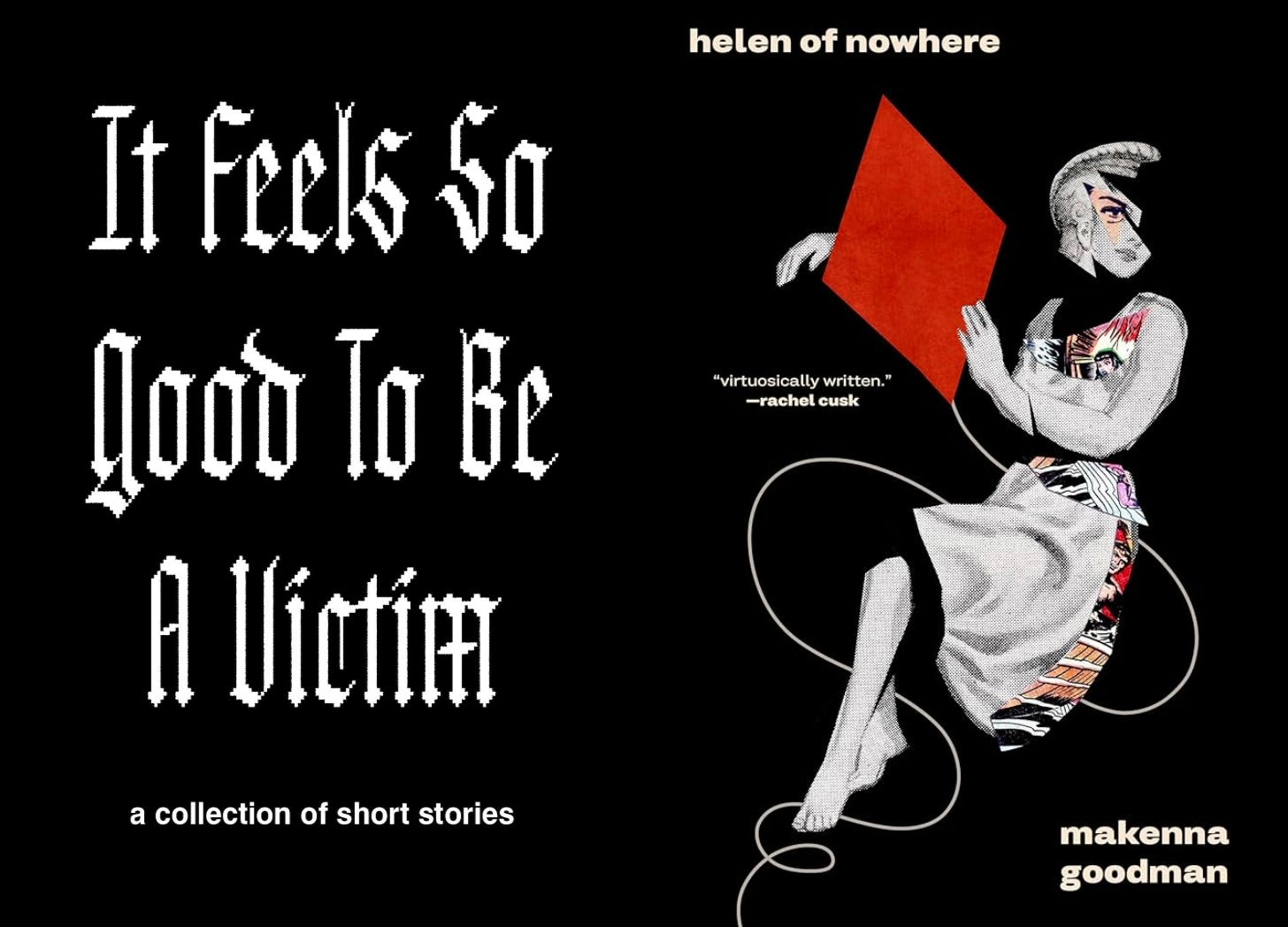
It Feels So Good to Be A Victim by Emma Newman-Holden (available June 5, 2026)
Helen of Nowhere by Makenna Goodman (from Coffee House Press (US), Fitzcarraldo Editions (UK))
Amazing 🩷🩷🩷🩷🩷 I’m so happy u enjoyed :)