
There Are No Old Times
Don DeLillo and Nelson Algren

It was so strange and pervasive that I knew I must make a joke of it, as I did, ultimately, with all those things I did not understand (DeLillo, 107).
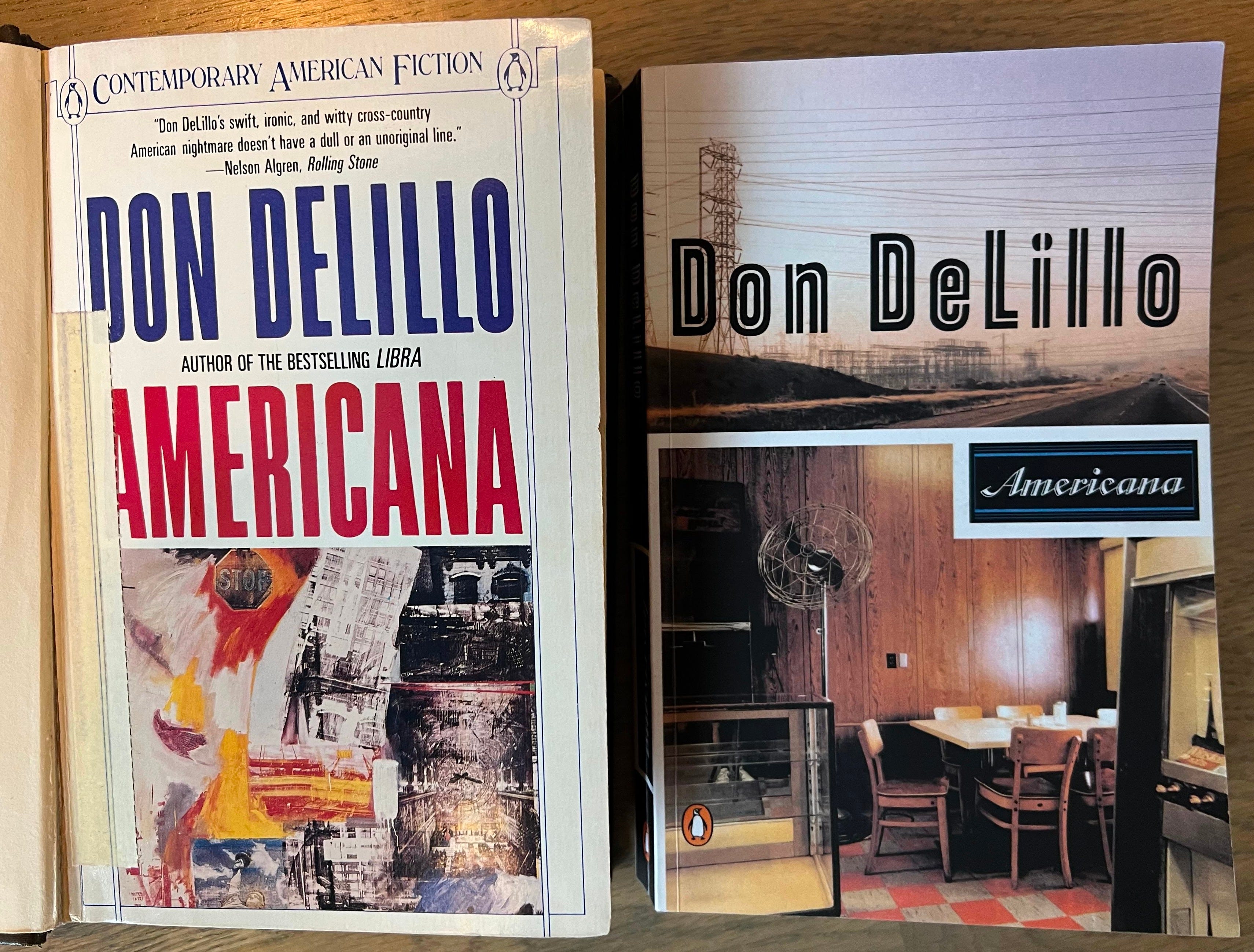
Americana, Don DeLillo’s first novel, was published in 1971 by the Houghton Mifflin Company and re-released by Penguin in 1989 with light revisions. The edition above, on the left, contains a blurb from Nelson Algren’s original Rolling Stone review (which, yes, I did dig up in its entirety).
I have a lengthy review coming of Americana, but for now you can watch my video on it here.
Part of the reason I read this novel, which is often (incorrectly) written off as a messy debut, is because of Algren. In Colin Asher’s biography of Nelson, Never a Lovely So Real, he details a meeting between Algren and DeLillo on Fire Island. DeLillo was trying to write but getting nowhere and Algren was writing what would become Notes From A Sea Diary: Hemingway All the Way, a later work that was, unfortunately, filled with sections of writing that obscured the work’s central ideas, in an effort to sabotage something he was not confident in.
As Jonathan Dee notes in a 2019 New Yorker article, Algren’s response to his diminishing reputation in those later years was “to try to beat posterity to the punch.”
Around 1960, unwilling to give the literary culture that had turned against him the satisfaction of seeing him wounded, he stopped writing novels, or even referring to himself as a novelist at all (preferring the term “journalist,” or “loser”). He showed up at various literary events dressed more or less in rags, and acted the clown there, as he did for journalists and other interviewers, lying about the facts of his own life and work in ways that made them seem less colorful rather than more. His efforts, sadly, were not unsuccessful. In the last years of his life, the work that Ernest Hemingway once said “beat Dostoyevsky” was so undervalued that much of it was out of print. (Dee, The New Yorker)
On Fire Island, Algren was living without electricity, so DeLillo let him borrow the manual typewriter he was (supposed to be) using. They became friends, and Nelson gave him feedback—harsh but honest, I’m sure—on his first stories, as well as portions of Americana.
Algren was against teaching, or at least the university model—he made a mockery of the Iowa Writers Workshop as well as the University of North Carolina—but when he came across a writer he knew it, often well before they did. He bestowed confidence in soon-to-be-novelists such as Russell Banks and DeLillo, both of which he met under awfully strange circumstances, and he wrote glowing reviews of the books he believed in. He even wrote direct letters to influential friends advocating for authors like Joseph Heller, whose famous novel Catch 22 struggled significantly upon initial release.
It’s not always easy to see the connection between Algren’s gritty realism and the work of someone like Don DeLillo, often referred to as a postmodernist. Perhaps even less so with a writer like Thomas Pynchon, who said the following in a letter to his agent:
I know he [Algren] is behind a great deal of what I do. I only wish I had not read the book right at this time because it raises certain inescapable truths about writing, being a writer in America, that I’ve been trying to avoid, like knowing the number of bars in a jail cell for one thing, the whole business of reconstruction, contrivance, as against naturalism in the American, its best sense.
As some of us gasp in surprise at the state of America, Algren reserves the right to say I told you so. He spent the back half of his life being harassed by the FBI—oftentimes unbeknownst to him—which led to that loss of confidence and diminishing success. I believe the connection between Algren and DeLillo lies in their visions of America, which are expressed in fundamentally different ways, though both tug at something dark and bleak and very funny.
DeLillo wrote a wonderful remembrance of Algren in Granta USA. My favorite line comes when he recalls “Nelson throwing a coffee cake at a temporary house-sharer - a man who thought Nelson ought to take his turn tidying up the kitchen.”
There are certain people, Asher says, who will drop everything when it comes to Algren. Russell Banks was one of them—he participated in this fantastic discussion with Asher upon the biography’s release. Don DeLillo is another. I don’t believe DeLillo shows up to literary events very often, if ever, but I do know he came to Chicago to celebrate Nelson in 2009.
There are some correspondences between the two of them that I’d like to read if I ever get to Austin.
Never a Lovely So Real by Colin Asher
Nelson Algren’s Street Cred by Jonathan Dee
Granta 108 (DeLillo’s Remembrance)