
Hello, Dystopia!
DAY OF THE OPRICHNIK by Vladimir Sorokin

When we first meet Andrei Danilovich Komiaga, he is dreaming of horses:
Always the same dream: I’m walking across an endless field, a Russian field. Ahead, beyond the receding horizon, I spy a white stallion; I walk toward him, I sense that this stallion is unique, the stallion of all stallions, dazzling, a sorcerer, fleet-footed; I make haste, but cannot overtake him, I quicken my pace, shout, call to him, and realize suddenly: this stallion contains—all life, my entire destiny, my good fortune, that I need him like the very air; and I run, run, run after him, but he receded with ever measured pace, heeding no one or thing, he is leaving me, leaving forever more, everlastingly, irrevocably, leaving, leaving, leaving…
Then BAM! Awakened by a cellphone. And not just any cellphone: its ringtone is the sound of men being whipped to death.
Andrei Danilovich is a member of the oprichina, a callback to Ivan the Terrible’s terror institution and secret police force, active in the late 16th century. In Vladimir Sorokin’s novel, Day of the Oprichnik, the police force has been resurrected: it is wintertime in Russia, early 2028, and a monarch, with his small but unquestioningly loyal group of supporters, is establishing a new order by bloodshed:
His Majesty looks at us with his expressive, sincere intent and penetrating blue-gray eyes. His look is inimitable. You’d never confuse him with anyone else. And I am ready without hesitation to give my life for this look.
Day of the Oprichnik’s title gestures towards One Day in the Life of Ivan Denisovich, the 1962 novel by Aleksandr Solzhenitsyn, which portrays a prisoner of the mid-20th-century Soviet labor camps, also known as the gulags. Ivan Denisovich was eventually banned by the Soviet Union—as was the work of a young Sorokin—though Denisovich was also famously banned on the local level in the U.S.
Sorokin is an interesting case, having begun his career under Soviet rule, and continuing his prolific output within Putin’s Russia. Sorokin has officially been in exile since the Russian invasion of Ukraine, and his works are highly censored and contested from every direction by every different kind of group.
He first rose to prominence with what he calls “binary bombs”: short stories that begin in the acceptable Soviet Realist tradition, and dissolve into something violently, graphically surreal. This ability to shift between modes and styles is important to keep in mind throughout Day of the Oprichnik—the novel itself represents a shift in Sorokin’s career, but there are also numerous small movements from a simple, almost boring style, to linguistically complex, incomprehensible scenes.
Day of the Oprichnik was released in 2006, still in the early years of Putin, and takes an opposite approach to Denisovich: portraying the enforcer of the state’s crimes, as opposed to its victims. Dirk Uffelmann says, in an essay on the novel:
In contrast to almost all of Sorokin’s previous novels, with the exception of 23,000, Day of the Oprichnik is a piece of psychological literature, uncovering the thoughts and opinions of the perpetrator.
A novel about the mind of a governmental terror-enforcer is especially pertinent in an America that is today, right now, kidnapping people without due process, deporting them to detention camps at random.
Komiaga, we learn, is coming off a night of coke and booze, a regular occurrence for the oprichniks: “I sit still, my head bowed and unwilling to wake up.”
Circles under my eyes are now the norm. All of us suffer from chronic lack of sleep. Last night was no exception.
Could “all of us” suffering from lack of sleep have to do with our crimes against humanity? Not in Komiaga’s view:
I disagree in principle with the cynic Mandelstam—the authorities are in no way “repellent, like the hands of a beard cutter.” They’re lovely and appealing, like the womb of a virgin needleworker embroidering gold-threaded fancywork.
What a poet we have on our hands! Stand down Mandelstam, you cynic!
Komiaga gets his beard shaven, breakfast in bed, he’s even dressed by a servant—of which there are many in his place of residence: “farmyard workers, the cook, the chef, the yardman, the game warden, the guards, the housekeeper…”
When compared with other secret police forces—such as the one forming now in America—Sorokin’s Oprichniks are rewarded quite handsomely. Perhaps he underestimates what is required to stoop so low.
Komiaga’s first mission of the day: having failed to plant “treasonous literature” on nobleman Ivan Ivanovich Kunitsyn yesterday, the oprichniks must now execute him without sufficient reason.
The totalitarian tendency is to run words like “freedom” and “truth” into the ground, to use them so often and so widely that they lose all meaning, so that, eventually, you can tell someone that a lie is the truth, that they are free when they are not, and they have neither the ability nor the desire to check you on it.
Sorokin plays with this weaponization of language, often using it to distract Komiaga from any objections that may be barely poking at the surface. Whether it be the music he listens to on the way to this execution—“Oh, You Wide Steppe,” a folk song about freedom and the beauty of Russian lands that “purifies” his soul—or in the way he frames his own surroundings: “Ah how I love the snow! It covers the earth’s shame.”
Or in how he interprets the morning’s news:
The news bubble is on the far wall. I give the command:
“News!”
The bubble flashes and the sky blue, white, and red flag of the Motherland with the gold two-headed eagle unfurls; the bells of the church of Ivan the Great ring. Sipping tea with rasberries, I watch the news: departmental clerks and district councils in the North Caucasus section of the Southern Wall have been stealing again. The Far Eastern Pipeline will remain closed until petition from the Japanese. The Chinese are enlarging settlements in Krasnoyarsk and Novosibirsk. The trial of moneychangers from the Urals’ Treasury continues. The Tatars are building a smart palace in honor of His Majesty’s anniversary. Those featherbrains from the Healer’s Academy are completing work on the aging gene. The Muromsl psaltery players will give two concerts in our Whitestone Kremlin. Count Trifon Bagrationovich Golitsyn beat his young wife. In January there will be no floggin on Sennaya Square in St. Petrograd. The ruble’s up another half-kopeck against the yuan.
Still, Komiaga is not without his doubts:
Each time I stand in Upensky cathedral, I think secret, treasonous thoughts on one subject: What if we didn’t exist? Would His Majesty be able to manage on his own? Would the Strelsty, the Secret Department, and the Kremlin regiment be enough?
And I whisper to myself, softly, beneath the singing of the choir:
“No.”
“What Sorokin demonstrates in Day of the Oprichnik is the physical and psychological means by which repressive social standards are imposed in a neo-totalitarian society,” says Uffelmann.
CLICHÉS ARE DANGEROUS: Komiaga justifying the death of Ivan Ivanovich: “When you’ve lost your head, you don’t fret about your hair. In for a penny, out for a pound. If you raise the axe, let it fall!”
The most language sensitive text since Sorokin’s debut novel The Queue, Day of the Oprichnik is a meta-linguistic or meta-socio-linguistic text. In contrast to The Queue, oral discourse is not the main meta-linguistic vector of the 2006 short novel. Oral stylization and idiosyncrasies, the famous Gogolian skaz, play a role in Komiaga’s stream of self-persuasion, but more importantly, the text focuses on the imagined purist and repressive language of a dystopian future (Uffelmann)
Notice that when we boil so much down into a word or phrase—the earth’s shame—we can dismiss it altogether:
Here the trees are even higher than ours: ancient, century-old firs. They have seen much in their time. They remember: they remember the Red Troubles, they remember the White Troubles, they remember the Gray Troubles, they remember the Rebirth of Rus. They remember the Transformation as well. We’ll be ash and fly off to other worlds, but the glorious firs of the Moscow Region will stand straight, their dignified branches swaying…
Whether it be nature, Russian government, or the very position of the oprichnik, Komiaga constantly deflects responsibility. He is in service to something greater, something that he feels he cannot (and, more importantly, should not) understand. The shame belongs to the earth. The Red Troubles, The Gray Troubles—time is lost to vague phrases.
This tendency to serve can be seen in the others as well: answering his second phone call of the day, Komiaga hears immediately: “Work and Word, We Live to Serve!” Soon after, his co-worker makes the mistake of using the expression “thank the lord,” when, in fact, God is not who they serve. “The Lord has nothing to do with it. Thank his majesty,” Komiaga replies.
After finishing the execution by assaulting the nobleman’s wife until she is unconscious:
Important work.
Necessary work.
Good work.
Without this work, a raid is like a stallion without a rider…without reins…a white stallion, white knight, white stallion…beautiful…brilliant…bewitched stallion…a tender stallion-galleon…a sugar-sweet stallion with no rider…no reins…no reins…with a white fiend…a sweet fiend…a fiend of sugar reigns…no rider…no rain, no galleon-stallion, galloping and no reins, so sugar reins, no sugary rains…galleon galloping where the white sugar fiend reigns and the distant sugar rains, faraway, the reins galloping, trotting, sugar reins, galloping, cantering, sugary caaaantering cuuuuuunnnnnntttt!
How sweet to leave one’s own seed in the womb of the wife of an enemy of the state.
Sweeter than cutting off the heads of the enemies themselves.
The widow’s tender toes fall out of my mouth.
In terms of the writing, the use of homophones here is astounding. I have no idea how it was translated. And in terms of content, Sorokin is certainly playing with one of the oprichina’s main tasks: to censor art. Komiaga says to a fellow oprichnik, when a book falls out of his coat:
This obscene stuff is subversive. There were purges in the Printing Department on account of these sorts of books.
At the same time, Sorokin is not especially graphic in the rape scene above—there is one in chapter seven that is far worse, which takes shape at the end of a poem, and yet one could imagine even that being more brutal than it is. In case you haven’t heard, Sorokin’s 1999 novel Blue Lard features a graphic sex scene between Joseph Stalin and and Nikita Khrushchev.
Sorokin’s sex scenes, often non-consensual or at least extremely twisted, are intended to displace the erotic. He seems to lunge toward a new, more modern kind of sex—one that takes neither romance nor physicality as its primary motive, but simply power. It becomes strictly psychological.
A controversy arises within the government when a (not so) satirical poem about the King’s son-in-law grows in popularity:
Tell us, Andrei, is it true?
The count says nothing, casts his eyes down, inhales, sniffs, and exhales carefully:
“It’s true, your majesty.”
Now His Majesty himself grows thoughtful, and frowns. We all stand there, waiting,
“So you mean to say that you actually like to fornicate at fires?” asks His Majesty.
The count nods his grave head:
“It’s true, your majesty.”
The ability of art to undercut the regime is reinforced throughout the novel; why ARTISTIC CONTROL is so essential to any tyrannical government.
We see this at perhaps its final form in our current times: the devaluation of art itself.
Komiaga’s inability to understand art is hammered home on several occasions; the novel is littered with poems and songs that he is constantly confounded by, or, more often, confidently misinterpreting. Komiaga comments on the artistic scene of Russia, specifically the underground scene, which, we imagine, is similar to the one Sorokin was a part of in the 1980s:
“Minimalism,” “paradigm,” “discourse,” “CON-SEP-CHEW-A-LISM”…From early childhood I’ve heard these words. But I still don’t understand what they mean. But take the painting Boyarina Morozova, now—just as I got to know it when I was five years old, I know it to this very day. All this “contemporary” art isn’t worth one brushstroke of our great artist Surikov.
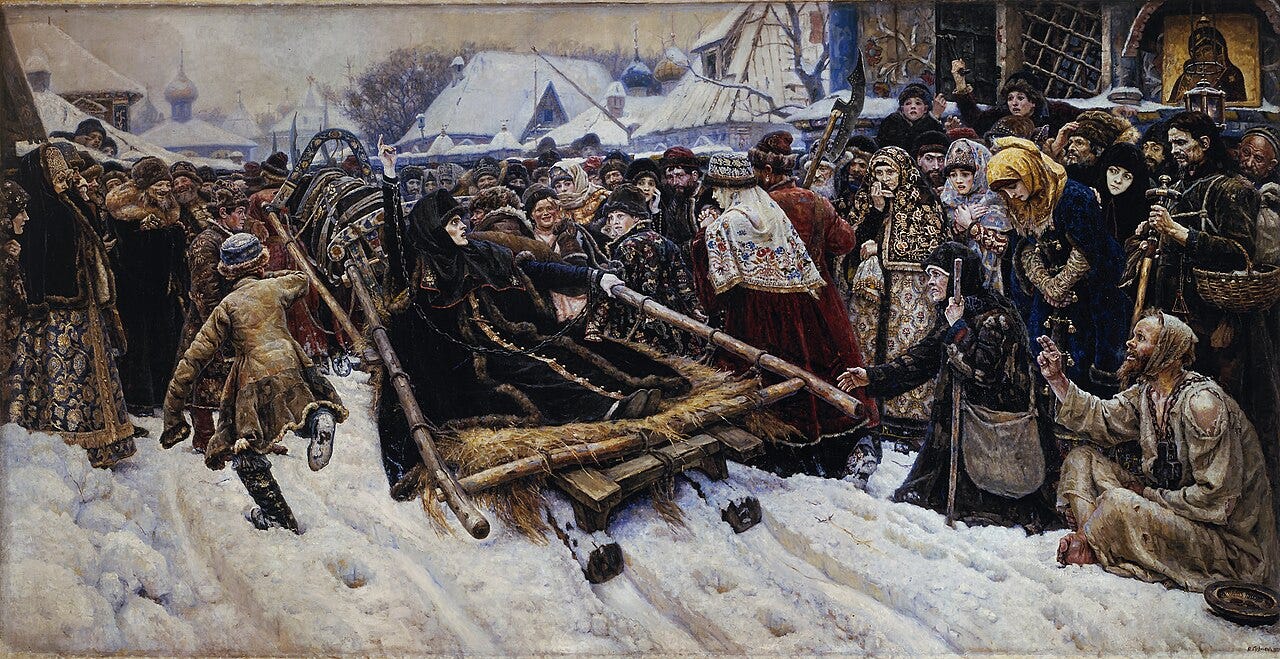
Sorokin undermines his own narrator with this painting—firstly, Komiaga dictates “contemporary” art. He is quite literally the reason for the output he despises—he vets every show at Kremlin concert hall, for example. But even more importantly, Boyarina Morozova depicts a Russian woman arrested by Tsar Alexei Mikhailovich’s authorities in the seventeenth century; it was created in opposition of what Komiaga stands for, just like the CON-SEP-CHEW-A-L works of “underground intellectuals.”
Komiaga’s takeaway from looking at the painting?
Russia explodes from the wall. So intensely that you’ll forget about the meaningless bustle of the world. Your lungs inhale Russian air. That’s all you need. And thank god…
In his mind, the “unruly boyarina” is being rightfully captured. And that is Russia.
The inability to take responsibility for a nation’s past is a major part of the novel, and is portrayed as a likely reason for this new totalitarian regime—merely the kind of variation on a theme that Sorokin deems Putin.
I was also struck by the cult-like nature of the operation itself, the way that the oprichniks worship not just His Majesty, but also Batya, their highest ranking member.
He was the first to whom His Majesty entrusted the Work. During difficult, fateful times for Russia, our rulers leaned on him. Batya was the first link in the iron chain of the oprichniks. After him other links were attached, fused into the Great Ring of the oprichina, its sharp barbs pointed outward. With this ring His Majesty drew a sick, rotting, collapsing country together, he lassoed it like a wounded bear, dripping ichor blood.
Komiaga uses the phrase “thank god” more than one would think—the religious contradictions are so excessive that it’s almost funny—and when he does, it is often in reference to Batya. Other moments in the novel, like an economic debate over Chinese policy, highlight the ferocity in which the oprichniks respond—or reinforce, rather—the opinions of their leader.
We clap till our hands hurt.
A more direct example: when Batya slaps Komiaga for saying “motherfucker,” and responds by telling him to fuck his “own mother.”
“Batya, you know my mother is dead.” I try to get him on pity.
“Fuck her in the grave.”
I’m silent as I wipe my split lip with my undershirt.
“I’ll heat the brazen, rabble-rousing spirit out of you!” Batya threatens us. “Whoever fouls his lips with curses—will not stay long in the oprichnina!”
We grow quiet.
The irony in this, of course, is that the leader of the oprichina does get to curse—and not just that: certain oprichiks experiment with drugs (injecting artificial fish into their veins!??), conduct transactions behind the government’s back, and, in the very scene quoted above, have some kind of masochistic orgy in a steam room WHILE taking bribes from His Majesty’s son-in-law (the man who likes to “fornicate in fire.”)
The final soliloquy of the novel comes from Batya:
Now you, my dear Enochs, you’re wondering, why was the Wall built, why are we fenced off, why did we burn our foreign passports, why are there different classes, why were intelligent machines changed to Cyrillic? To increase profits? To maintain order? For entertainment? For home and health? To create the big and beautiful? For fancy houses? For Moroccan leather boots, so everyone could tap their heels and clap? For all that’s good and true, and well made, so that there’d be plenty all around? To make the state as mighty as a pole from the heavenly tamarind tree? So that it supports the heavenly vault and the stars, goddamnit, so the stars and moon would shine, you sniveling scarecrow wolves, so that the warm wind would blow-not-stop-blowing on your asses, is that it? So your asses would stay nice and warm in your velvet pants? So your heads would feel cozy under their sable hats? So you sniveling wolves wouldn’t live by lies? So you’d run in herds, fast, straight, close together, most holy, obedient, so you’d harvest the grain on time, feed your brother, love your wives and children, is that it?
Batya pauses, inhaling a good snort of white coke and washes it down with vodka. We do the same thing.
“Now you see, my dearest Enochs, that’s not what it was for. It was so the Christian faith would be preserved like a chaste treasure, you get it? For only we, the Orthodox, have preserved the church as Christ’s body on earth, a single church, sacred, conciliar, apostolic, and infallible, isn’t that right? …We have rejected everything sacrilegious: Manichaeanism, and Monotheletism, and Monophysitism, right? For whomsoever the church is not mother, God is not the father, right? For God by His nature is just beyond understanding, right? For all true-believing Orthodox priests are heirs of Peter, right? For there is no purgatory, only hell and heaven, right? For man is born mortal and therefore he sins, right? For God is the light, right? For our Savior became human so that you and I, sniveling wolves, could become gods, right? That’s why his majesty built this magnificent Wall, in order to cut us off from stench and unbelievers, from the damned cyberpunks, from sodomites, Catholics, melancholiacs, from Buddhists, sadists, Satanists, and Marxists; from megamasturbators, fascists, pluralists. and atheists!
Because in the end, it is the church that they want you to believe in, not God; and the state that they want you to believe in, not the land.
The use of “Enoch” is interesting, likely referencing the prophet Enoch, who walked with god and was taken to heaven without experiencing death. As Uffelmann puts it, “The joint devotion to the monarch and the totalitarian state implies pseudo-sacralization of the authorities.”
His Majesty’s father, the late Nikolai Platonovich, had a good idea: liquidate all the foreign supermarkets and replace them with Russian kiosks. And put two types of each thing at every kiosk, so the people have a choice. A wise decision, profound. Because our God-bearing people should choose from two things, not from three or thirty-three. Choosing one of two creates spiritual calm, people are imbued with certainty in the future, superfluous fuss and bother is avoided, and consequently—everyone is satisfied.
In Sorokin’s 2024 interview with Blake Butler, translated in real time by Max Lawton, he mentions being unable to read or write since Putin’s “senseless” invasion of Ukraine, adding that “now isn’t really the time for literature or for fiction.” He reads some reports by political scientists and experts, but little else.
This is not something I can disagree with him on—a writer of Sorokin’s stature can be said (in jest, but only partly) to have metamorphosed into LITERATURE ITSELF. But I can say that now is not the time for you or for me to stop reading. If anything, it is a call for reading more—but also, for reading only what TRANSFORMS US.
Day of the Oprichnik is a reminder that the emptiness inside you will be filled. And if you do not choose what to fill it with, the world will choose for you.
ART IS THE ENEMY OF THE STATE.
To end with my favorite Kafka quote:
I think we ought to read only the kind of books that wound or stab us. If the book we’re reading doesn’t wake us up with a blow to the head, what are we reading for? So that it will make us happy, as you write? Good Lord, we would be happy precisely if we had no books, and the kind of books that make us happy are the kind we could write ourselves if we had to. But we need books that affect us like a disaster, that grieve us deeply, like the death of someone we loved more than ourselves, like being banished into forests far from everyone, like a suicide. A book must be the axe for the frozen sea within us. That is my belief.
Sources:
Day of the Oprichnik by Vladimir Sorokin (trans. by Jamey Gambrell)
Vladimir Sorokin’s Discourses: A Companion by Dirk Uffelmann